
Artificial Intelligence (AI) and Everyday Life
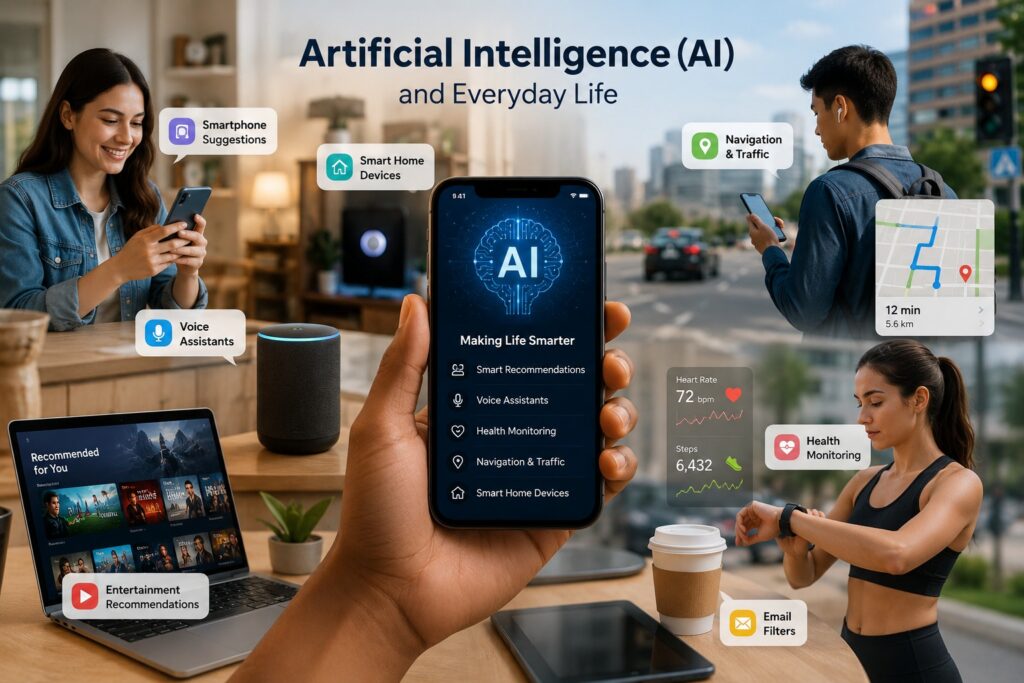
Artificial Intelligence, commonly known as AI, is no longer something found only in science-fiction movies or advanced research laboratories. Today, AI is part of everyday life, often working quietly in the background to make tasks easier, faster, safer, and more convenient. From the moment people wake up until they go to sleep, they may interact with AI through smartphones, social media, online shopping platforms, navigation apps, smart devices, and many other digital tools.
AI has become one of the most important technologies of the modern world. It is changing how people communicate, learn, work, travel, receive healthcare, enjoy entertainment, and make decisions. Although some people imagine AI as a human-like robot, AI is much broader than robotics. It includes computer systems and software that can analyze information, recognize patterns, learn from data, make predictions, understand language, and perform tasks that usually require human intelligence.
As AI continues to develop, its influence on daily life is expected to grow. Understanding how AI works and how it affects society can help people use it responsibly and benefit from the opportunities it creates.
AI in Our Daily Routines
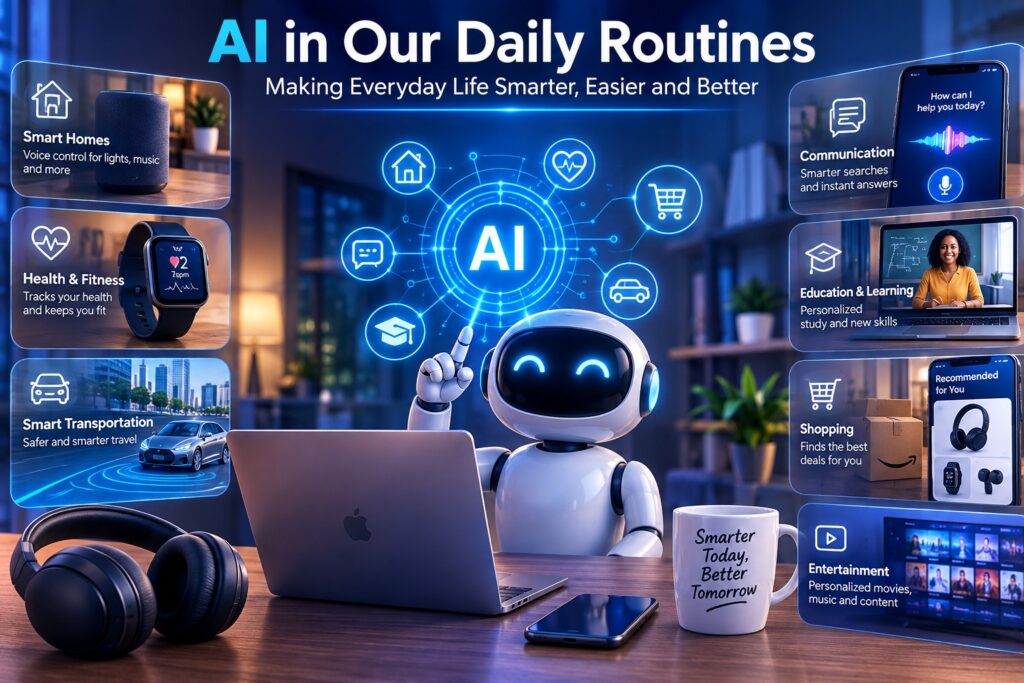
Many people interact with AI before they even leave their homes. Smartphone alarms can learn sleeping habits and suggest better wake-up times. Voice assistants can answer questions, set reminders, play music, control smart devices, and provide weather information.
When someone asks a voice assistant for directions or tells a phone to send a message, AI may be used to understand the spoken words and respond appropriately. Speech-recognition technology has improved greatly and can now understand different accents, phrases, and languages more accurately than in the past.
AI is also used in smartphone cameras. Modern cameras can automatically detect faces, improve lighting, reduce blur, enhance colors, and adjust settings based on the scene. Some phones use AI to improve low-light photographs or remove unwanted objects from pictures. Smart home devices also use AI to make homes more convenient. Smart thermostats can learn preferred temperatures and adjust heating or cooling automatically. Smart security cameras can detect movement and send alerts. Some smart lighting systems can follow schedules or respond to voice commands.
These tools may appear simple, but they show how AI can save time and reduce the effort required to complete routine tasks.
AI in Communication and Social Media
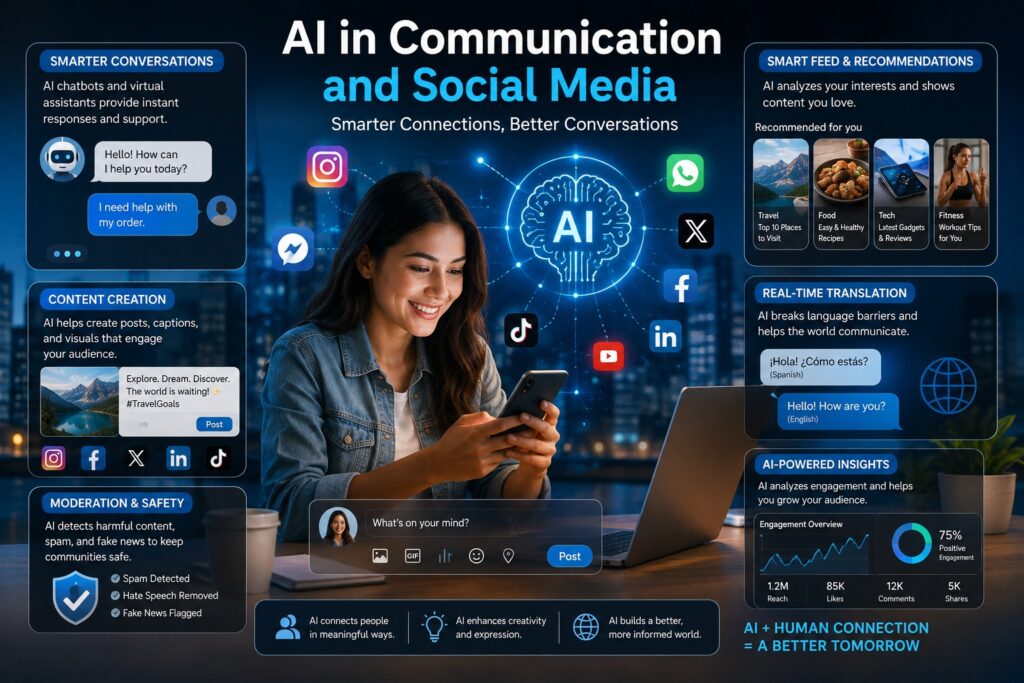
AI has changed the way people communicate and connect with others. Social media platforms use AI algorithms to organize content and recommend posts, videos, accounts, and topics that may interest users.
For example, when a person watches several technology videos, the platform may recommend more technology-related content. AI analyzes information such as viewing history, likes, comments, searches, and interactions to make these suggestions.
AI also helps reduce language barriers. Translation tools can translate text, speech, websites, and conversations between different languages. These tools allow people from different countries to communicate more easily.
Email services use AI to identify spam messages and protect users from suspicious emails. Some email applications suggest quick replies or help users write messages. AI-powered grammar tools can identify spelling mistakes, improve sentence structure, and suggest clearer wording.
Customer-service chatbots are another common example. Many companies use AI chatbots to answer frequently asked questions, provide information, help customers track orders, and offer support at any time of the day.
Although AI makes communication faster, users should remember that AI-generated information may sometimes be incorrect. Important information should be checked using reliable source
AI in Education and Learning
AI is transforming education by making learning more personalized and accessible. Students can use AI tools to explain difficult topics, generate practice questions, summarize information, improve writing, and receive feedback.
An AI learning system can adapt to a student’s pace. If a student struggles with a particular topic, the system may provide additional explanations or easier exercises. If the student understands the topic quickly, the system may offer more advanced questions.
AI can also support teachers. It may help create lesson plans, organize educational materials, prepare quizzes, and identify areas where students need additional support. This can save time and allow teachers to focus more on teaching and interacting with students.
Online learning platforms often use AI to recommend courses based on a learner’s interests and progress. For example, a student studying programming may receive suggestions for courses on Python, web development, data analysis, or cybersecurity.
AI can make education more inclusive. Speech-to-text tools can help people who have difficulty typing. Text-to-speech tools can read written content aloud. Translation tools can help learners understand educational materials in other languages.
However, students should use AI as a learning assistant rather than allowing it to complete all their work. Learning requires practice, critical thinking, and personal effort. AI can explain and guide, but students still need to understand the information and develop their own skills.
AI in Work and Productivity
AI is changing the workplace by helping people complete tasks more efficiently. Many professionals use AI to write drafts, organize information, analyze data, create presentations, summarize documents, and manage schedules.
In offices, AI tools can help sort emails, schedule meetings, create reports, and identify important information. AI can automate repetitive tasks, allowing workers to spend more time on creative work, problem-solving, and decision-making.
Content creators use AI to generate ideas, edit images, create video captions, improve audio, and plan content. Designers may use AI tools to create concepts or explore different visual styles. Writers can use AI for brainstorming, editing, and organizing ideas.
Businesses use AI to understand customer behavior. By analyzing customer information, AI can help companies recommend products, predict demand, and improve customer service. AI is also creating new career opportunities. Jobs related to AI development, data science, machine learning, cybersecurity, AI ethics, and digital technology are becoming more important. At the same time, some jobs may change because certain repetitive tasks can be automated.
This means that learning digital skills will be increasingly valuable. Skills such as critical thinking, communication, creativity, problem-solving, and the responsible use of technology may become even more important.
AI in Healthcare and Wellness
AI is helping healthcare professionals improve diagnosis, treatment, and patient care. AI systems can analyze medical images, identify patterns, and assist doctors in detecting possible health problems.
For example, AI may help examine X-rays, scans, and other medical images. It can process large amounts of information quickly and highlight areas that may require further attention. However, AI should support healthcare professionals rather than replace their judgment.
Wearable devices such as smartwatches use AI to track physical activity, heart rate, sleep patterns, and other health information. These devices can help users understand their habits and encourage healthier lifestyles.
Health applications may provide reminders for medication, exercise, hydration, or appointments. Some AI-powered tools can help users
AI in Shopping and Online Services
AI has made online shopping more personalized. When customers visit an online store, they may see product recommendations based on their searches, purchases, or browsing activity.
For example, someone searching for a laptop may receive recommendations for laptop accessories, computer bags, wireless mice, or related products. AI can help customers discover products that match their interests.
AI is also used to improve customer support. Chatbots can answer questions about products, delivery, returns, and payments. Some systems can help businesses predict which products may become popular.
Online stores may use AI to detect unusual transactions and reduce fraud. This can help protect customers and businesses.AI-powered price tools can compare products and help shoppers find better deals. However, users should still compare prices, read reviews, and check product information before making a purchase. A recommendation does not always mean that a product is the best choice.
AI in Transportation and Travel
AI plays an important role in transportation. Navigation applications use AI and real-time information to suggest routes, estimate travel times, and help drivers avoid traffic.
Ride-hailing services may use AI to connect passengers with drivers, estimate fares, and predict demand. Public transportation systems can use AI to improve schedules and manage traffic.
Modern vehicles may include AI-powered safety features such as lane assistance, automatic emergency braking, parking support, and driver-alert systems. These features can help reduce accidents and improve road safety.
AI is also being developed for self-driving vehicles. These vehicles use cameras, sensors, maps, and AI systems to understand their surroundings and make driving decisions. Although the technology is advancing, fully autonomous transportation still faces technical, legal, and safety challenges. In travel, AI can recommend hotels, flights, tourist locations, and activities. It can also help translate languages and provide travel information.
AI in Entertainment
AI has changed the way people enjoy music, movies, games, and online content. Streaming platforms use AI to recommend movies and shows based on viewing habits. Music services suggest songs and playlists based on listening history.
Video platforms use AI to recommend content that users may enjoy. AI can also generate captions, improve video quality, and help creators edit content.
In gaming, AI controls computer characters and can make games more realistic. Some games use AI to adjust difficulty based on a player’s skill level. AI can also help create game environments, animations, and interactive experiences.
AI-generated art, music, images, and videos are becoming more common. These tools allow creators to experiment with new ideas and produce content more quickly. However, AI-generated content raises questions about copyright, originality, and misinformation. People should be careful when sharing AI-generated images or videos because some may look realistic even when they are not genuine.
Benefits of AI in Everyday Life
AI offers many benefits. One major advantage is convenience. AI can automate routine tasks and help people complete activities more quickly.
AI can also improve accessibility. Voice assistants, translation tools, speech recognition, and text-to-speech systems can support people with different needs and make digital services easier to use.
Another benefit is personalization. AI can recommend content, products, lessons, and services based on individual interests and needs.
AI can improve safety by detecting suspicious activity, identifying possible risks, and supporting security systems. In healthcare, transportation, and cybersecurity, AI may help professionals respond to problems more quickly.
AI can also support innovation. Researchers and businesses can use AI to analyze information, discover patterns, and develop new solutions.
The Future of AI and Everyday Life
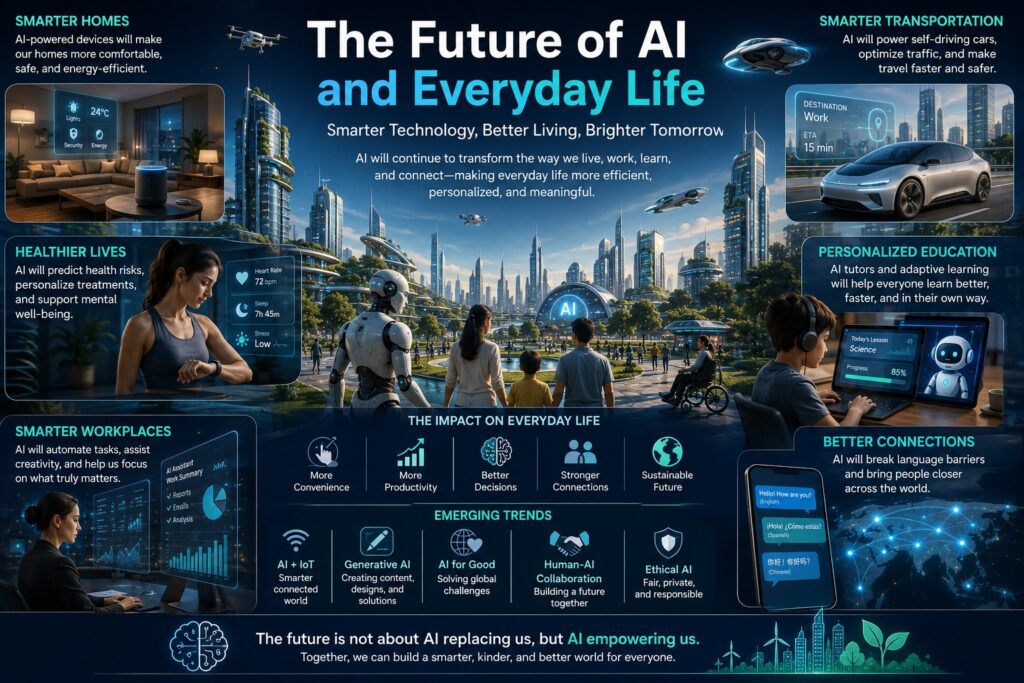
AI will likely become more integrated into daily life in the future. Smart devices may become better at understanding user needs. Education may become more personalized, healthcare systems may become more efficient, and workplaces may use more AI-powered tools.
Future AI systems may communicate more naturally and work across different devices. People may use AI assistants to manage schedules, plan trips, organize work, learn new skills, and complete everyday tasks.
However, the future of AI will depend on how people choose to develop and use it. Governments, technology companies, educators, researchers, and users all have a role in ensuring that AI is safe, fair, and beneficial.
Responsible AI should protect privacy, reduce harmful bias, provide reliable information, and remain accountable to people. Technology should support human well-being rather than create unnecessary harm.
Conclusion
Artificial Intelligence is already an important part of everyday life. It helps people communicate, learn, work, shop, travel, manage their health, and enjoy entertainment. Many AI tools operate quietly in the background, making technology more useful and convenient.
AI offers exciting opportunities, but it also creates challenges involving privacy, accuracy, fairness, employment, and misinformation. To benefit from AI, people need to understand how it works and use it responsibly.
The goal should not be to allow AI to replace human thinking. Instead, AI should be used as a powerful tool that supports creativity, learning, productivity, and better decision-making.
As AI continues to develop, digital skills and critical thinking will become increasingly important. By staying informed and using AI wisely, individuals can take advantage of its benefits while recognizing its limitations. Artificial Intelligence is not only a technology of the future. It is already shaping the way people live today, and its influence will continue to grow in the years ahead.